Free delivery on orders from 500 DHConditions

Kaktus — home

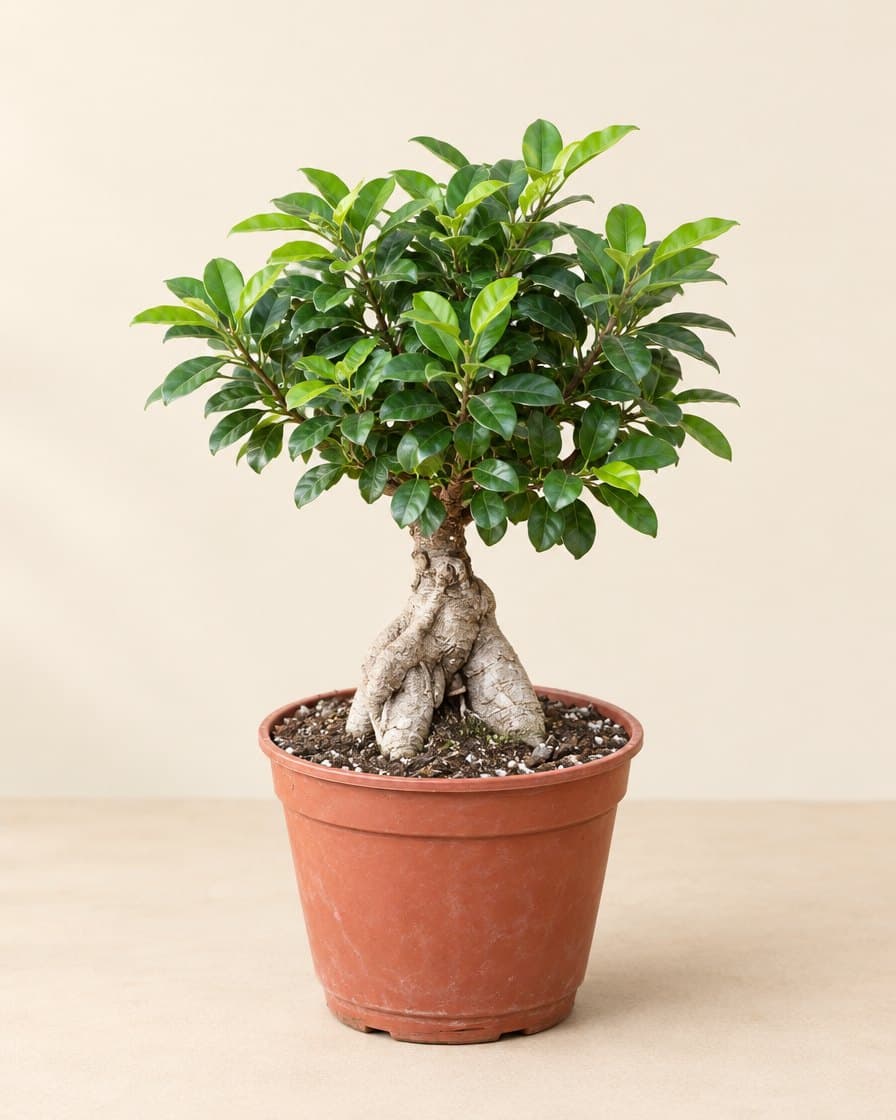
Small Ficus Ginseng bonsai with a swollen trunk in a terracotta-coloured pot, on a cream background

Ficus Ginseng bonsai

Ficus microcarpa

A sculpted trunk with thick roots and a crown of small glossy leaves: a true indoor bonsai, easy to live with.

Light
Partial shade
Water
Moderate watering
Care
Intermediate
Heat
Moderate heat
Pets
Mildly toxic

At a glance

Botanical name
Ficus microcarpa
Also known as
Ficus Ginseng · Ficus bonsaï
Mature height
30 to 100 cm
Growth
Slow growth
Environments
Indoor · Office
Pets
Mildly toxic to pets

Care

What this plant needs

For each area, the instruction specific to this plant, then the general principle that explains why.

Water

For this plant

The principle

A moderate need asks for regularity rather than volume. Water when the top three to four centimetres feel dry: in practice weekly from May to September, every ten to fifteen days the rest of the year. Adjust for the pot — terracotta dries twice as fast as fibreglass.

Light

For this plant

The principle

Partial shade is bright but filtered light: a metre back from a glazed door, behind a sheer curtain, or morning sun only. It is the broadest and easiest exposure to achieve in a Moroccan interior. Direct afternoon sun, by contrast, leaves irreversible bleached patches on the leaf.

Feeding

For this plant

The principle

A slow grower consumes little: two or three half-strength feeds between April and August are enough. Over-feeding does not speed it up — it burns the roots and leaves a white crust on the substrate. Repotting every three years renews most of its reserves.

Temperature

For this plant

The principle

This plant is comfortable between 15 and 30 °C, the range of a Moroccan interior all year. Above 35 °C, move it out of direct sun and water more often without watering more heavily. The most common enemy is not the heat but the dry stream of an air conditioner aimed at the foliage.

Yearly rhythm

Indicative calendar

Calendar derived from the plant's profile — water need, heat tolerance, environment and growth rate — applied to the Moroccan climate; adjust it to your city, your exposure and your substrate.

Indicative twelve-month care calendar
JanFebMarAprMayJunJulAugSepOctNovDec
WateringWatering in January: ReducedWatering in February: ReducedWatering in March: RegularWatering in April: RegularWatering in May: RegularWatering in June: RegularWatering in July: RegularWatering in August: RegularWatering in September: RegularWatering in October: RegularWatering in November: ReducedWatering in December: Reduced
FeedingFeeding in January: Nothing to doFeeding in February: Nothing to doFeeding in March: ReducedFeeding in April: ReducedFeeding in May: ReducedFeeding in June: ReducedFeeding in July: ReducedFeeding in August: ReducedFeeding in September: ReducedFeeding in October: Nothing to doFeeding in November: Nothing to doFeeding in December: Nothing to do
PruningPruning in January: Nothing to doPruning in February: Nothing to doPruning in March: RegularPruning in April: RegularPruning in May: Nothing to doPruning in June: Nothing to doPruning in July: Nothing to doPruning in August: Nothing to doPruning in September: Nothing to doPruning in October: Nothing to doPruning in November: Nothing to doPruning in December: Nothing to do
IntensityNothing to doReducedRegularSustained

Morocco

Where this plant thrives in Morocco

Our observations city by city, crossed with the local climate. A city that is missing is not a refusal: it simply has not been documented for this plant yet.

We have not documented this plant city by city yet. Write to us and we will answer with the detail for your neighbourhood.

Diagnosis

Three signals worth reading

The three most common disorders on a plant with this profile, and the move that corrects them.

  1. 1

    What you see

    Dry brown leaf tips and edges, foliage that droops late in the day and recovers overnight.

    Likely cause

    Alternating neglect and compensation: the root ball dries out completely, then receives too much at once.

    The right move

    Fix one watering day a week and check with a finger before you pour. Trim brown parts with scissors, following the leaf's shape; they will not turn green again.

  2. 2

    What you see

    Bleached then brown patches in the middle of the most exposed leaves.

    Likely cause

    Direct afternoon sun through glass — the magnifying effect scorches the blade in a matter of hours.

    The right move

    Pull it back a metre or hang a sheer curtain. Marked leaves will not repair, but the next ones will be clean; remove them only if more than half is scorched.

  3. 3

    What you see

    Lower leaves dropping and tips browning in the weeks after a move or a change of season.

    Likely cause

    Adaptation stress: the plant is adjusting its foliage to a new quantity of light.

    The right move

    Change nothing for a month — no repotting, no feeding, no moving. Keep watering regular and remove only the leaves that are entirely dry.

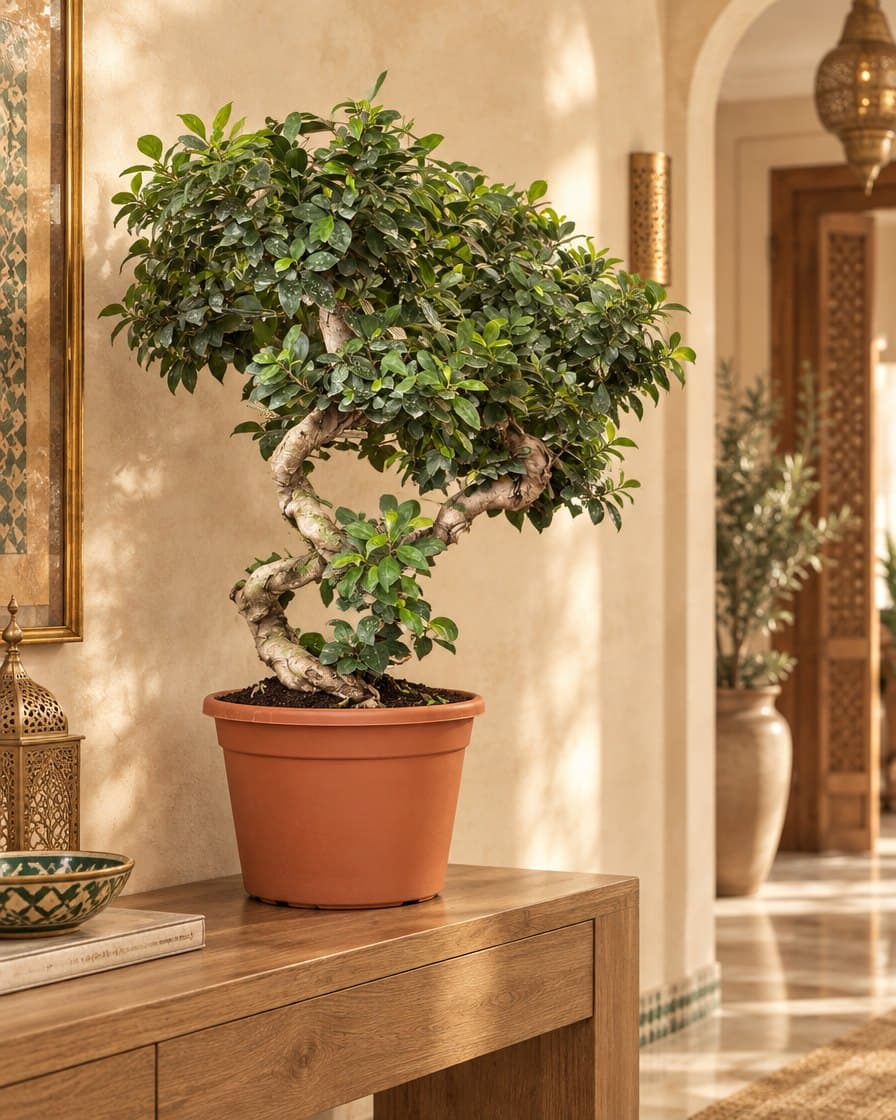
Large Ficus Ginseng bonsai with an S-shaped trunk on a wooden console in an entrance hall

Take the step

Ready to join your space?

Every available size, the premium setup and delivery across Morocco are on the product page.

Ficus Ginseng bonsaiFrom250 DHAvailable